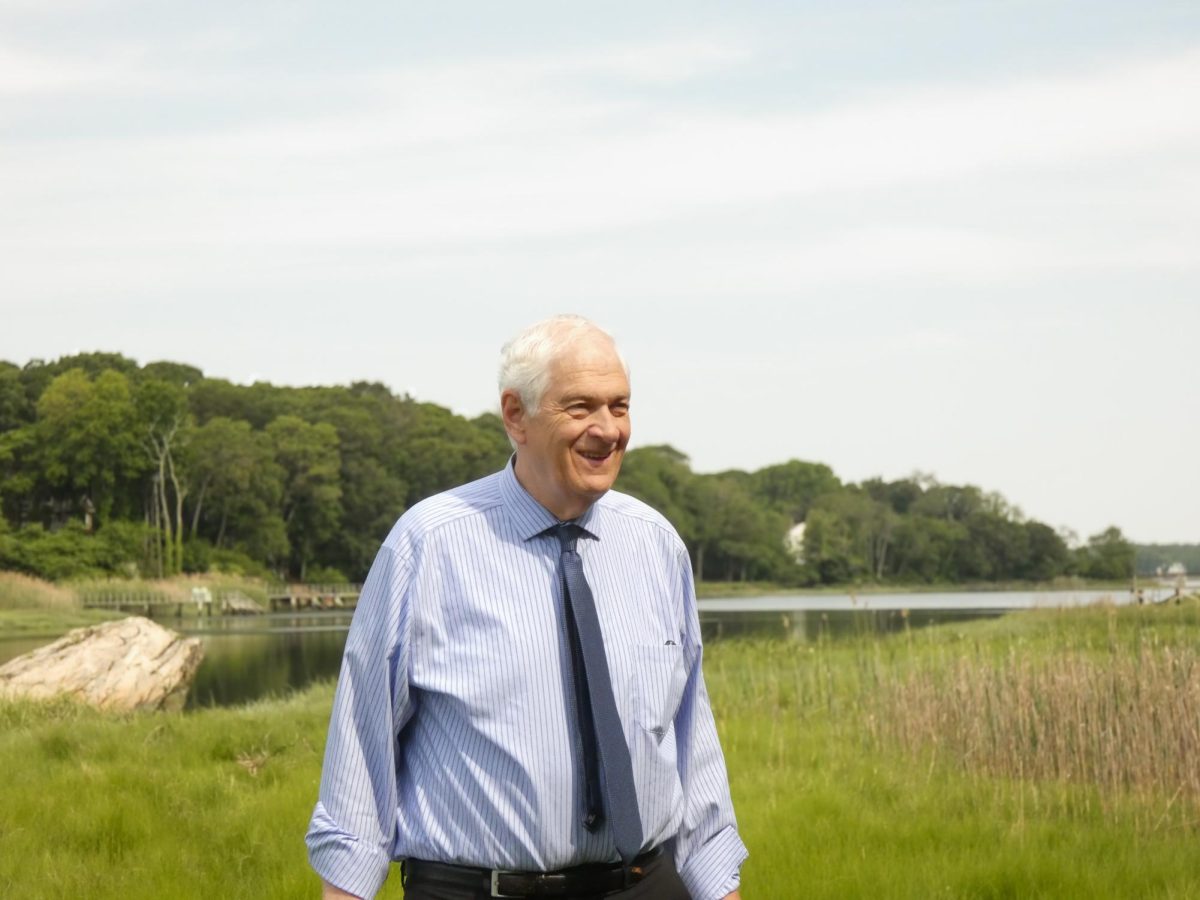



Christopher Gallant is running for Congress in New York’s 1st Congressional District. He is the favorite to secure the Democratic nomination against Lukas Ventouras in the June 23 primary. If he advances to the general election, he will seek to unseat incumbent Representative Nicholas LaLota.
Below is a transcript of Kaleidoscope’s interview with Chris Gallant, lightly edited for clarity. A profile of him and his candidacy can be found in the June 2026 Print Edition, found here.
Kaleidoscope: What has inspired you to run for Congress at this particular moment? What do you think the biggest issue for the district is currently?
Chris Gallant: I think my biggest thing has been that, for many years now, Congress has just not been able to get anything done. They have had their lowest approval rating now ever. I think that currently there has been zero respect for the three branches of government and checks and balances. I think that’s the main reason why I’ve decided to run. With my background in both the military and the fire department, having that service to my country, I think this is just the next calling to change the uniform and to serve my country in a different way. With my background, I have the ability to really bridge gaps, bridge divides, and come up with real solutions to real problems. And that’s what I’m going to do in Congress. I’ve seen a lot of people who have had prior military experience that are current sitting members of Congress that have been very successful in their careers. That is an influence to me that I’d be able to do the same. They would be people that I’d be able to lean on for support and advice on how to run a great campaign.
Congressman LaLota has been ranked by various organizations as more effective than 92% of Republicans in Congress, more bipartisan than 85% of members of Congress, and more independent than 95% of House Republicans. Do you have any comments or rebuttals to these statistics?
Nick LaLota oftentimes creates problems to try to turn around and fix them and to appear bipartisan. I don’t find Nick LaLota to be bipartisan at all. Nick LaLota has often touted himself as being bipartisan. He’s not really viewed very much as being bipartisan. He’s oftentimes voted in line with just Donald Trump without actually voting for things that really matter to the district. My goal here is to be a representative of New York 1. By showing up and actually getting people to have an avenue to discuss their problems. So whether you’re Democrat, Republican, or independent, your representative is supposed to represent you. That’s the big difference that I want to bring here. That’s why I’ve been holding town halls. The whole goal here is to give a voice to the people that you represent, and we’ve lost that. Nick LaLota doesn’t do that at all. He doesn’t show up. There’s a lot of people who are really complaining about the fact that he doesn’t show up, that he doesn’t talk to his constituents, that he doesn’t hold any town halls. That’s a problem. So when we talk about being effective, he’s not effective for his constituents. And that’s the real issue.
You have a lot of different views from Congressman LaLota, but what issues most separate you from Lukas Ventouras, your opponent in the Democratic primary?
The biggest difference is I have a lot of experience behind me, both in the military, in the FAA [Federal Aviation Administration] as an air traffic controller, as a union representative, as a union president, and as a volunteer firefighter. I sit on several different boards. I’m a junior vice commander of my VFW [Veterans of Foreign Wars] chapter. I have experience in real life and in the world. I’ve been to all but one state out of all the states in this country. I’ve been to over thirty five countries around the world. So when we talk about worldview and things, I’m not looking at it as a perspective through a textbook. I’m looking at it through a perspective of, “I’ve been there and I’ve seen it.” I’ve worked with coalition partners overseas while deployed. I’ve had two deployments. I was deployed in 2012, and I was deployed in 2022 to 2023. Those conversations that you have with other partner forces around the globe are important, and they give you a real-life communication tool or real-life avenue into understanding. I think that’s the biggest difference. I’ve had a lot of experience. My military career has allowed me to grow substantially. I’ve worked with every three-letter agency when I worked at the Javits Center during COVID: I was the safety officer for the unified command there. I was able to make an actual impactful change working with every three-letter agency you could possibly imagine. Some of them I didn’t know existed until then. That was really a very interesting moment in my life where I was able to realize I actually had the ability to impactfully make change that is not only effective, but supports doctors, nurses, and the workers that were there at that time. So it really comes down to experience. I think that’s where I am head and shoulders above Lukas.
Do you have any specific issues that you think separates you from him?
I think, in some instances, I have a much more pragmatic approach to certain things. My goal here is to try to work with Congress in order to eventually get what our end goal is. Lukas has talked about a Medicare for All program, which is the hammer down on healthcare. And while I agree eventually — yes, we have the greatest country in the world and we should all be entitled to free health care — we have to get there. And I don’t think that we can just, all of a sudden, turn the light switch and have that happen one day with Medicare for All. In particular, we have a lot of union workers here on Long Island. So I was looking towards more of a hybrid system, something similar to Switzerland and Germany, where employees still have the option to get an employer-provided program while every American still would be entitled to free health care as well. That was kind of my idea: how do we work towards that? The first step I would absolutely take is, the Democrats are attempting to have Medicare cover dental, hearing, and vision, which I think is a huge step. I think that is one of the bigger key issues that we misalign on. In general, we’re both Democrats and we have really good ideas for our country and for our community. I think, for a lot of them and many of them, we do align on. I don’t know that there’s any one particular issue that is so outlandish that we are very divisive on. But I have more of an approach that I think is effective in a lot of the things that we discuss.
You have outfundraised and outspent Lukas Ventouras, yet it is his campaign signs that are visible across the Three Village area. Do you have any explanations for this discrepancy?
Yes. I have found that that is not necessarily a great, very effective way to get our message out. What we’ve been doing is we’ve been actually utilizing volunteers. We have a huge volunteer base. And so we’ve been actually door knocking. We’ve been doing door knocking for months now. Getting into doors and getting literature to people where they’re at has been far more effective. Unfortunately, campaign yard signs cost a lot of money. So we have had some of them go out, but that just wasn’t our priority, and that wasn’t our really big push to do. That’s why that’s that way. We’ve been using other methods and tools in order to get our message out.
This is a red district, and it has been moved off of many lists of Democrats’ top targets. How do you plan to flip this seat, and what gives you confidence that you’ll be able to do so?
We have been working very strategically to put us on the map. There is a lot of involvement nationally in this race. I don’t necessarily want to get into too much detail because, again, there’s a strategy here. There is a lot of national attention on this race. Although it may not appear so right now, there is. There’s a lot of local attention as well on this race. We think that, if there was ever a year to actually flip this seat, that this is it. And there’s been a lot of momentum across the board. Lukas and I have agreed that we’re not going to do any mudslinging or anything like that. A race for Congress should be won on merits, on your policies, and on your positions. And let the people decide. That’s the message we’ve been getting across and that has been very helpful. People are very excited about this race, again, both locally and nationally. Also, I’m a very unique candidate in comparison to candidates that have been run here in years past, more so because I’m the blue collar guy from Long Island that is relatable and can talk to people really easily. People genuinely feel that it’s a good conversation, and I show up. Showing up is really the key to everything. Holding these town halls, holding meet and greets across the district, and really getting to know people has been very helpful.
There’s a lot of tension between both political parties and independents, and you’re specifically running in a time when many voters distrust both political parties. Why do you feel that independent voters could believe that your campaign offers something different?
With my background in the fire department and the Army, they lean very to the right. There is a very heavy prevalence of Republican members that I work with. I’m often told by them that I would be probably the first Democrat that they’d ever vote for, because they like my approach on a lot of issues. It’s not just talking at people with campaign slogans or talking at people with just the regular rhetoric of everyday politicians. People are looking for someone who’s not a politician. And I’m not: I’m just a regular guy. That has been something that’s been really relatable to a lot of people in general. Even Republicans and independents, they’re looking for change as well. The temperature of this country is way too high. It has been for a long time, and it’s time to start coming back to the table, start working together again, and start actually making laws that are effective. And that’s what I’m going to do when I get to Congress.
Many Long Island residents are concerned about rising property taxes, and you have openly said that you would try to combat this issue. What specific actions would you support to ease this financial burden on Long Island homeowners?
There’s a couple of things. I have a big focus on our children, particularly high school and college-age students, because they are the ones who are struggling the most when it comes to trying to afford to live on Long Island. A lot of younger adults are leaving here because it’s just too expensive. Some of the incentives that I think we should be able to bring back to New York 1 is, have some kind of tax rebates for people who are going to school in order to maybe afford their first-time homes, so that here on Long Island, it’s not so expensive. I think that is really going to get a lot of students to stay here and continue their education here.
That kind of leads into the fire department issue that we have. We have a lot of volunteers here on Long Island. The volunteer fire departments are a big part of our community. And they are struggling very hard to get volunteers for many reasons, one of which is that a lot of young adults are not only going to school but also trying to work two jobs to survive. If we can get some kind of incentive for them to join the fire department, that would be an attractive avenue to get people to stay here. I looked at Shelter Island and they have probably the most prominent gap. Oftentimes when kids leave home, they’re leaving and they’re probably never coming back, because you can’t really even buy a one-bedroom or a two-bedroom house for anything less than $1.2 to $1.5 million on Shelter Island. When we look at the fire department that’s there, they have this really serious gap where a lot of the people that are volunteering are much older. So I think we should be able to get some kind of incentives to help younger generations with their education and their housing. Those would be ways that we can keep people here. I’m actually all for rebates for clean energy. Clean energy is something that’s really big. This administration has really gutted a lot of the incentives for clean energy, particularly with solar panels or buying electric cars. We’re moving in the right direction, or we were moving in the right direction. We just have to continue bolstering that.
You pledged to expand housing responsibly near LIRR stations while also promising to protect suburban neighborhoods from overdevelopment. However, many Long Island communities often resist transit-oriented zoning overrides. How do you propose to build the necessary volume of affordable housing if local zoning boards use your pledge of protection to block these very projects?
As a federal congressman, I won’t necessarily hold the tools to tell what towns to build what where. What I can do, though, is I can bring federal funding here that will help bolster affordable housing and allow the towns to decide on where they’d like to build. At the same time, I would be holding corporations accountable for buying up affordable housing and price gouging. That would be my role in helping with the affordable housing provisions.
Suffolk County residents have been dealing with many delays due to old Long Island Railroad infrastructure. What transportation improvements would you support or advocate for in Congress, whether for the LIRR or other projects?
Infrastructure is one of my top priorities. Long Island is not prepared for the next hurricane. I will do everything in my power to make sure that we get federal funding and federal dollars here to help our infrastructure. Our roadways, our bridges, and the railway really need this funding to help bolster up improvement. I would do everything we could to help the Long Island Railroad, particularly because I know they want to electrify the East End. I think that’s a big push that they’re trying for. Also, adding more areas where rail cars could pass each other would increase the number of trains that would actually be able to get out to the East End. I would really be working with a lot of our local government agencies in order to figure out how I can be most effective with that and how I can actually bring in federal dollars for those things. I know the Long Island Railroad is a huge one, because I think there’s only three trains a day that go out to the East End. That’s really a struggle. That would also reduce a lot of the traffic flow that goes out there. It’s all cumulative.
Small businesses across Long Island have had increasing burdens due to inflation and labor shortages. What policies would you support to help local businesses stay competitive?
As a federal congressman, the big thing would be tax incentives for them. A lot of the small businesses are really affected by town policy or local policy rather than federal policy. But I would support any federal legislation that would help small businesses improve or to not have such a burden when it comes to taxes. I’d have to do a little bit more research into exactly how I can be effective there.
On your website, you wrote, “The people of Long Island deserve leaders who stay focused on them, not on political theater.” How do you plan to ensure your focus remains on the concerns of residents, and how would you actually measure whether you’re truly delivering these results to your constituents?
That really all ties into showing up, holding town halls, actually having conversations with people, understanding what it is that they need and what I can do for them, and providing that. I think I speak for most Americans when I say that we’re so tired of the political theater and the political rhetoric all the time. It’s exhausting. I know I’m tired of it. For the last ten years, the kitchen table conversations have revolved around politics. I remember before that people really hardly ever spoke about politics. So it really is a temperature issue with the way this country has been. My focus is really going to be on issues, what it is that I can do for the American people, and what I can do for my constituents and be effective in that. The barometer on that will be holding these town halls and having these conversations, having regular updates, having people understand what I’m doing and what I’m voting on. If it’s something that maybe would require more voice of the people, I’m again holding these town halls. Most of them are in person. My goal here is to hold a town hall in every town: at least once a month, hold a town hall somewhere different in the district so that everybody has the opportunity to attend. At the same time, we could possibly hold a general Zoom meeting. I plan to make sure that I’m at all the Democratic meetings that I can make, so this way I’m accessible. A representative is supposed to represent the people. Again, I think with the way our politics has gone, we’ve lost that.
Is there any specific way you would measure how you are delivering what your constituents want?
Well, that would come from the town halls. We also utilize a lot of social media: people comment, and we read comments. If we try to lean forward on a specific policy, feedback from that would be great. Also, sending emails to all of our constituents or doing surveys would be a barometer on that. But we will definitely be working towards figuring out exactly how we can measure each step that we take and get feedback from all of our constituents across the board, whether it’s Democrats, Republicans, or independents. Because I’m supposed to represent everyone, not just Democrats, not just independents, but Republicans as well. I think that’s important. I’m actually looking forward to even going to some of the Republican town committees. I’m happy to walk into their room and tell them who I am and explain to them why I think I’m the right candidate for the job, and then listen to them as well. Listening is half the job.
What are your thoughts on the increasing use of artificial intelligence in schools and workplaces? Do you believe that Congress is moving fast enough to regulate the technology, as well as the building of data centers?
I think AI in schools takes away from education in some ways. Because it makes it easier for students to get an answer without actually having to think about the answer. Everything’s at your fingertips, and it’s so easy to access information. Does the learning sometimes now stop on certain things? I think those are issues that need to be explored. As I do with everything that I do, I would be referring to experts in the field, particularly education experts I’ve sat with. When I talk about healthcare, I’ve sat with healthcare experts. So education is one of those things as well. I have sat with some educators, and we’re having a panel put together in order to discuss these issues and how those effects really occur. That would be how I would move my policies in that direction. I think that we, as a country, are somewhat behind. The technology of AI is advancing so fast that we just don’t realize it.
Now, is there an environmental impact on some of these data centers? Sure. It is using a ton more electricity than we possibly imagine. Again, we go back to infrastructure. It’s creating great strain on our power grids across the board. If we can find clean energy in order to run these data centers, that would be amazing. I mean, look at Apple. Apple has a net zero facility, and their facility is huge. That’s a huge data center. So if we can focus on net zero data centers, that would be the ideal thing to address those concerns.
You’ve spoken about public safety during your campaign. How would you balance support for law enforcement with concerns about transparency and accountability?
I work with law enforcement a lot through the fire department. We see them every time we get on a call. I support the police department. They basically make sure we maintain law and order. I think that they are a well-trained force. I think that the Suffolk County Police Department has gone through steps to make sure that they have well-trained police officers. I support and back the blue 100%: it’s probably one of my less Democratic, more Republican ideals. But I work with them all the time, and they’re people doing their job. I feel that a majority of them do a very good job, and they do everything that they can and they put their heart and soul into their careers.
But yes, I think transparency is key. If you’re talking about what this administration has done with ICE in particular, there’s problems and big issues there. I had called for Kristi Noem to be fired prior to her being let go because there was no transparency there. She created a police force that essentially attacked our cities, and they focused on blue states. When we looked at what happened in Minnesota, they had ICE agents that had little to no training in some regards. They essentially were hiring people without background checks, without actual schooling, education, and understanding of what their job was. ICE was also operating well outside their purview. What they’ve been doing with ICE is not what ICE was designed for. Those are problems, and accountability would be essentially holding hearings and understanding what it is that this agency and administration has done. That’s how we would hold accountable those who have been pulling the strings on these things. That’s basically what I would do: holding hearings and holding people accountable for what they’ve done is really the big thing.
Do you believe the immigration system needs broad reform?
Absolutely. What we’ve seen is the end result of not fixing the actual problem. The actual problem is that the clear pathway to citizenship is not so clear. It’s not so easy. Those avenues have been restricted even further by this administration by essentially firing the workers that are there to give a pathway to citizenship. There have been many judges that have been fired too. If there’s no clear pathway to citizenship to come to this country and to actually be a part of this country, then that’s causing the problems that we see with immigration. I think that’s the root cause of it. It’s not the flood gates that have been opened and everyone just coming here. It’s that there’s no clear pathway to citizenship. We need to bolster that up.
Climate change has increased coastal flooding in communities such as Patchogue or Mastic Beach. We were talking about infrastructure before; what infrastructure protections would you implement for vulnerable shoreline areas, especially on Long Island?
It would depend on where it is and some of the specifics. Again, a lot of that comes down to more of a town issue. My goal would be to bring federal funding here or get more resources from the Army Corps to maybe bolster up beaches. Jetties have been a real help in making sure that there’s not so much washout or runoff. Reinforcing our dams and bridges that we do have is also necessary, because a lot of them in the district are starting to crumble. They are aged out. They are past their years of being rebuilt or redone. We see that, because we’ve seen several dams and bridges washed away. So bringing federal federal dollars here to help fix those things would be my goal.
The state and local tax deduction cap was recently raised to $40,000 for five years. Do you support this provision of the One Big Beautiful Big Act, and do you believe that more work needs to be done?
Yes. I mean, Nick LaLota talks about SALT so much that I’m going to send him a case of it. But the thing is, when we talk about SALT, Donald Trump initiated this whole cap to really affect blue states, particularly New York and California, where taxes are much higher. So this problem was created by this administration. Nick LaLota is touting that he’s upped the cap to $40,000. The problem is, he didn’t finish the job. It expires. And if he never touched it at all, the entire SALT cap would have sunset anyway. He touts that he made a change, but it’s temporary, and it needs a lot more work. It just needs to be taken away altogether.
As an FAA air traffic controller, do you have any plans to address issues such modernizing outdated FAA automation systems or reducing staffing shortages?
As far as the problems go with actual air traffic control staffing, we see this all the time when I say that government shutdowns are not good for anyone. Nobody wins in a government shutdown. When we see these government shutdowns that affect the FAA, it causes a stop on hiring. It causes a stop on schooling. It causes a restriction on actual on-the-job training: training essentially stops. Having these gaps that are a month or two months or even a couple of days is a detriment right now. The staffing levels are at an all-time low. When I got into the agency in 2014, it was at an all-time low, and it’s only gotten worse because the stress levels that these controllers have is something that most people can’t really believe or understand. In a lot of these larger facilities, most controllers are only getting four days off a month, and the pay hasn’t kept up with it. If we compare where air traffic is with pilots, the pilots’ pay has gone up exponentially, probably two- or threefold, but air traffic controller wages have stayed stagnant. With the stress of increased prices and increased cost of living, their wages hasn’t actually met that. And now you have no time off to spend with your family. Pilots have fourteen days off a month; controllers have four. They’re at a breaking point, and a lot of the controllers that are working now are stressed out beyond belief. It just seems like there’s no relief. So increasing staffing, figuring out how to go about that, and getting federal funding to fix it is a key priority. They’ve been talking about the NextGen system for a decade, so when it’s still not implemented ten years later, it’s a problem. We need to make sure that the funding gets there and that even if the government does shut down, these are programs that just don’t stop. They have to continue to be built and to be improved, and we have to make sure that we still continue to have the safest airspace system in the world.
You said that you would openly work across party lines if elected. Are there specific ways that you would show people that you are able work across party lines in such a divided time?
Everything starts with a conversation. Right now, Democrats and Republicans are not having those conversations anymore.
At this point, we were unfortunately disconnected from Chris Gallant. We thank him for his time.