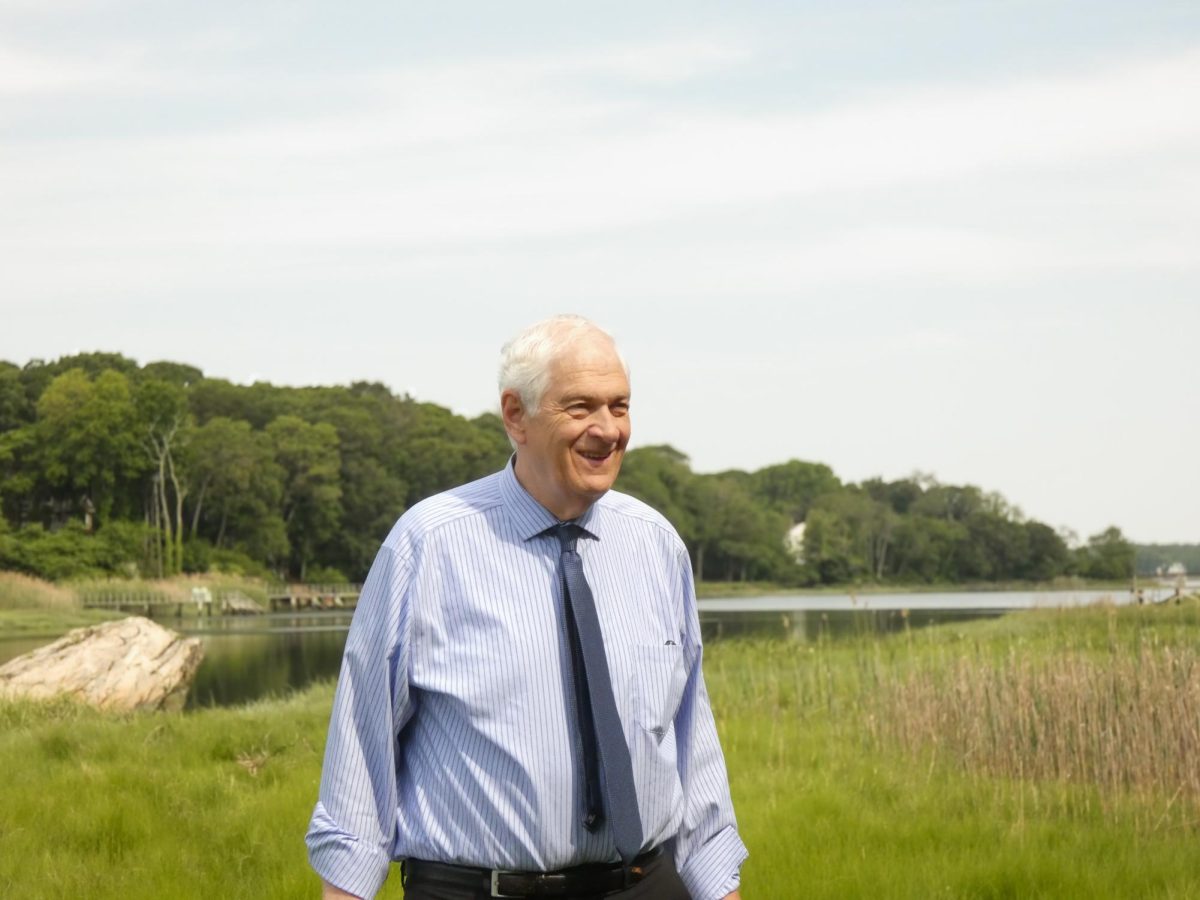



Why are you running for Congress now, and what is motivating you to enter the race?
I’m running for a few reasons. A lot of it has to do with my experience in politics. Since I graduated high school, I’ve been organizing. When I went to NYU, I founded the Students Demand Action chapter, which works with Everytown for Gun Safety and Moms Demand Action. When I was in law school, I was the president of the Constitution Society; worked on a lot of campaigns, congressional, county executive, or otherwise; worked in a congressional office; worked in journalism; and worked in civil rights law. All these experiences brought me very close to the political process for a young person. And honestly, I was really dissatisfied with what I was seeing. I would have never dreamed of running for office at 25 if I didn’t think that we were in a very dire moment that needed very drastic change.
Working with the Democrats in Suffolk County, I had a firsthand experience of what we were doing right, perhaps, but mostly what we weren’t doing right. I think the definition of insanity is doing the same thing over and expecting different results, and I kind of figured that was the direction we were headed in. So I figured, why not throw my hat in the ring and offer a different perspective for people who feel like they want that. That’s kind of why I’m doing that.
I’m very young, but I think that other than just an age difference that we need, we also just need a generational mindset and perspective shift. Regardless of age, I think I’m able to provide that.
I want to talk a little bit about your campaign and your opponents. Congressman LaLota has, by various organizations, been ranked as more effective than 92% of Republicans in Congress, more bipartisan than 85% of all members of Congress, and more independent than 95% of Republicans in the House. Do you have any response to this?
I think that it’s very easy to be bipartisan when the bills that are being passed bipartisanly are not actually helping or materially impacting the working class. I do think that metrics like these are sometimes very misleading, because it doesn’t actually give you a full perspective or a picture on what these bills are that are being passed. I think that if Republican members of the House are working with, for instance, [Senator] John Fetterman on a bill and that’s passed in a bipartisan manner, that’s not a bill that we want to see just because it’s bipartisan. I can give you an example: the DHS [Department of Homeland Security] funding was passed somewhat bipartisanly. There were bipartisan votes on a lot of the bills during the Trump administration. That doesn’t make them good pieces of legislation.
With regard to the independence, I think that he’s not a bad politician, and I’ve always said that. He’s from a district where you need to show a bit of an independent streak. But I think he chooses to do that in bills that are purely messaging rather than have any material impact. So that’s how I would probably counter that.
We know that you have disagreements with Congressman LaLota, but what issue most separates you from Chris Gallant, your opponent in the Democratic primary?
I’ve always said that everything is downstream of corruption and money in politics, and I stand pretty firmly against money in politics. Corruption being my motivating force is probably the thing that really differentiates me from Chris, because Chris is taking money from a lot of similar people who donate to Republicans. I’ve always posited that, in order for a representative to be truly accountable to the people and truly be able to work for the people, they need to be unmoored from corporate interests. I think that that’s probably the biggest difference between ourselves, because I kind of make corruption the crux of my campaign: trying to overturn Citizens United, trying to get dark money out of politics, trying to stop the assembly line of members of Congress that turn into lobbyists or members of corporate boards. I think that’s wrong, and it’s kind of a perverse incentive structure for “leaders” who want to serve the public. I would say my focus on truly rooting out unsavory forces from our campaign system is probably our biggest difference.
Chris Gallant has outfundraised you and he has outspent you. How do you compete against a better funded opponent?
I think that kind of goes back to my previous answer, in that I think who you get funding from is extremely important. I’ve had over 4,500 individual contributions at around $24.73 per donation. I think that that’s really important because, yes, I’m raising less money, but I’m raising money from people who allow me to run my campaign to the fullest extent that I see fit. That means that I’m constantly out in the community. I’m constantly holding events. I’m constantly attending events. And social media doesn’t really cost much to operate. I think that we’re in an era where simply being outraised doesn’t mean that you will be the victor. I mean, if you look at the general election for the same seat in 2024, I think LaLota was outraised two to one by John Avlon, and he beat him extremely comfortably. [Editor’s note: While Ventouras correctly states that Avlon outraised LaLota, Federal Election Commission reports show a closer margin than he suggested.] I think that proves that.
Some of the people that [Gallant] has taken money from, it probably distorts his ability to truly talk about the issues in a way that I’m able to. I’m able to hopefully attract a greater coalition of people who are looking for maybe more of an outsider candidate who is willing to talk about the difficult issues that aren’t typically discussed. That’s probably what I would say to that. Even in Q1 of 2026, I actually outraised him, and purely by grassroots funding. [Editor’s note: This is false. According to the FEC, Gallant raised $117,546.50 during that time period, while Ventouras raised $76,116.03.] I think that shows that you can rely on the spigot of corporate money, but it’s not always consistent: they could kind of pull the rug out from under you at any time that they want. But when you’re raising money from regular people because what you’re saying resonates with them, you have a greater potential of victory because you’re allowed to run your campaign as you want.
We know you’re only 25, which is the minimum age needed to run for the house. Do you think you have requisite experience to serve?
Yes, I do. I think that’s a good question because, as a young person and as a young candidate, the burden of proof is on me to prove my capacity and my capability to serve. When it comes down to my experience, I’ve worked in a civil rights law firm. I’ve worked in political journalism. I’ve worked in a congressional office and also on congressional campaigns. I’ve done a lot of advocacy work. I feel that these experiences that have taken me around politics and politicians have not just sharpened my sense of what I think needs to be accomplished and achieved but also my understanding. Obviously, nobody goes into Congress 100% ready to be a congressman. That’s why you have orientation and training and so on. But I think that my political experience — especially contrary to my primary opponents’ political experience, which is none — I’ve definitely learned a little bit on how to maneuver these Beltway institutions.
I also think that the youth is an additive, because I’m also not young enough to be too jaded and not know that the system needs to be pushed and new things need to be tried. I think that my youth and my experience are a good combination.
Many of the political positions you’ve taken categorize you as a progressive. What do you say to Democratic voters who may agree with some of your positions but believe that you may be unable to win in a fairly red district?
There are a couple things I can say to that. I can be categorized as progressive and I have no problem with that label, but I don’t necessarily outwardly use that label because I do think it can be counterproductive, especially in a district like ours. Obviously, people are not stupid: they know I’m the more progressive guy. But I think sometimes the way you brand yourself goes a lot further than people might give you credit for. So I just call myself an FDR Democrat or a New Deal Democrat, because I think that highlights what about progressivism I’m talking about: working class issues, and making sure that the working class and the government are more in sync than they’ve been in a long time.
For anyone who will say, “You might be too progressive for the district,” what I would say in return is: first, we’ve never ran a progressive or a progressively-minded person in this district, so we don’t have the data to prove that they can’t win. Secondly, we’ve had really bad strategy in the sense that our candidates haven’t truly explained why their positions are important, why they are salient, and why they could be salient to people.
If you look at the actual “moderate” Democrats in the House, most of them are pretty big corporate-funded candidates. So if being moderate means that you’re a corporatist, then I’m not moderate. But I think the actual moderate positions in this country, which poll at like 75 to 80 percent, are universal health care, universal child care, child tax credit, and paid leave. Things like this are what I’m actually advocating for. These are actually closer to being moderate positions than I think traditional media and conventional wisdom give credit for. So I’m trying to also change the way people discuss and think about a lot of these issues, because I think they’ve conveniently been tarred and feathered as out of the realm of possibility by people who have a stake in not seeing these policies be achieved.
You’ve written that “it’s time to put cordiality aside.” Can you expand on this mindset and how it will affect your ability to serve your constituents in Congress?
I don’t remember exactly the context I said that in, but that’s kind of my response to people who say that we always need to reach across the aisle. At its core, it’s something that I do want to agree with: that we should work together on a bipartisan basis. But I think when someone shows you who they are, you should believe them. When Republicans like LaLota cut our healthcare, cut veterans’ access to benefits, are directly responsible for rural hospital closures, and so on, we should believe them when they tell us what exactly they want to do. And I think it’s farcical that Democrats would want to work alongside people who have the complete opposite goal as them.
When I say to put cordiality aside, I think back to this age-old Nancy Pelosi quote, where she says that we need to return back to the normal Republican Party. But there is no normal Republican Party, in my opinion. (And when I say this, I’m talking about the politicians.) 50 years of billionaire funding, the Heritage Foundation, the John Birch Society: all of these institutions have been pushing Republicans and Republican voters in a direction that I personally don’t agree with. I see no reason, when my goal is to achieve universal health care, to try to work with a Republican who calls that communism and socialism and Maoism. To me, that isn’t realistic because I want to legislate and I want to achieve things. And why would I water down my dreams and my aspirations just for them to be voted against at the end of the day? I think we need to also stop always being on the defensive as Democrats.
Listen, I have Republicans in my life that I love. I really don’t mean this about the voters, even when I have disagreements with them. But Republicans, especially our president, have gone on record saying some of the most heinous things about Democrats and liberals. I think that we are in an era that requires some fighting back, and if we continue to be on the defensive instead of actually attacking for the good of our constituents, then we will continue to lose. I do think that people in Suffolk County are looking for someone who can throw a haymaker, but a haymaker that hopefully brings material change. I don’t want to be a bomb thrower. I’m not like a Lauren Boebert or a Marjorie Taylor Greene. I actually have genuine policies that I want to achieve. But I do think it’s silly that we are overly nice to a Republican caucus that treats us terribly.
On your website, you write negatively about globalization and the outsourcing of jobs. How do you plan to implement these protectionist goals?
When you say protectionist, I agree with the framing of your question, but I’m not one of those people that wants to shut off the country. I think global trade is very important. At the same time, global trade and trade policies need to materially benefit the working class of this country. When you look at things like TPP [Trans-Pacific Partnership] and NAFTA [North American Free Trade Agreement] and other trade deals which have allowed outsourcing at the material cost and loss of the American worker while also helping solidify an overseas system of indentured servitude, which I also don’t agree with on a human rights level, I think that that’s a problem. I wish I could say that we just need to do this or that and global trade will be fixed. But I think it requires a very concerted effort on the part of our government to start on-shoring jobs. The CHIPS [and Science] Act was a great start, but it takes five to 10 years for everything from the CHIPS Act to be implemented properly, and that’s without intervention from the Trump administration.
Overseas and global trade, it’s important. But the absolute number one priority should always be the American worker, and the fact that this country used to be the superpower of manufacturing and now probably couldn’t tell you what we make in this country, I think that’s a really big problem. It’s not America First in the sense that we can only care about ourselves. I think we should care about all people. But global trade that benefits the 1% or the 0.1% who are making money hand over fist because they’re implementing systems of indentured servitude in Southeast Asian countries or South American countries — they are consistently making money while the American worker is losing money and workers across the world are being treated unfairly — I can get behind none of those things. My goal is to just be a voice in Congress for the betterment of the American worker. Like I said, I wish I had a magic policy. But I think it’s going to require a lot of work and a lot of negotiations to get to where I want to see us get.
Affordability is a big issue in the midterms and on Long Island. Housing costs have soared and prices continue to rise. What actions would you support to make life on Long Island, and especially housing, more affordable?
You need to assist first time homebuyers with some sort of monetary assistance. I’ll leave that a little bit open because I think it will be up for debate and negotiation. But some non-negotiables for me are that private equity should be banned from buying housing stock. If you’re a renter — I’m a renter — and if your property owner owns more than five properties, the yearly increase in rent needs to be capped at either 2% or indexed with inflation and “rising” wages. We also need to see the Faircloth Amendment repealed, which is a Clinton-Gingrich-era rule that basically limits the federal government from spending money on affordable housing units. It also caps the number of units allowed by that specific agency. These are things that we can undo and hopefully see the federal government stimulating this development. I think we need mixed-zone housing, multiple-family housing units, single-family housing units, and affordable housing, but also city planning that creates more walkable spaces and areas for us as a society. Long Island is a very car-centric place, and that contributes to the unaffordability crisis because now you’re paying a ton for gas, and you’re paying a lot for childcare so you can go work in the city. I think that when it comes to housing, we need to also stimulate job opportunities out here. As I said, the federal government and the state government have a hand in creating communities that are both accessible and livable, maybe walkable, and maybe with more green space. One of the things that I’ve always wished more about Long Island is that it looked less like a giant highway. As much as I love Long Island, I think that there’s something to be said for the pride that you take in the communities that you live in and the way they look. That’s not a gentrifying thing. We want to keep our communities as they are, but we want to make them more livable. We want housing in these communities to be accessible to people. We don’t want to see young families have to leave, but we also don’t want to see elderly people being priced out of their small home that they want to live in. I’ve talked to many people [for] who[m], because of health care costs, housing has now become unaffordable. All of these things really disappoint me, and I don’t really ever see Democratic politicians on Long Island even raising these issues.
The SALT deduction cap was recently raised to $40,000 for five years. Do you support this provision of the One Big Beautiful Bill Act, and do you believe more work needs to be done on this front?
Yes, more work needs to be done. As for the first part of your question, in 2017, the SALT cap was put at $10,000. This undid almost 100 years of precedent in our tax code with regard to the deduction. I think it’s good that homeowners are able to get that deduction. I do have mixed feelings about it at times because I feel that a lot of it is state tax policy that is materially hurting working class people. I do support us working on this SALT deduction because we are a very highly taxed society. I love the belief that the Republicans in the federal government are specifically targeting blue states with higher taxes because they want to punish us for living in blue states. It kind of shows the asinine way that the Trump Republicans look at politics, because they’re looking at a state that goes blue on Election Day statewide. But we live in Suffolk County, and as you mentioned earlier, it’s more of a red district than a blue district. There are plenty of Republicans, Democrats, and independents in this district who are just purely working class, but who get treated as if they’re these very rich outeasters who can just pay for whatever, as if it doesn’t matter what tax costs they incur. It always feels like the tax burden is being pushed on the middle and working class rather than being fairly shifted somewhat to the 0.1%. So I do absolutely agree with having some relief for homeowners on Long Island, but the fact of the matter is that it’s more of a Band-Aid solution than an actual solution. I’d be looking to hopefully have a say in our tax code that lessens the burden on some county residents, whether it’s SALT or something else.
I don’t mean to give a vague answer. I just think that LaLota touts this victory. He says, “I put $4,000 into your front pocket,” but he’s taking out God knows how many dollars from your back pocket with rising premiums, healthcare costs, housing costs, gas, costs of raising children now. All these things are attacks on the working class, and I don’t think that SALT is enough, because it’s an all-encompassing issue.
You wrote about price gouging on your website several times, whether for the Long Island Railroad or grocery stores, but these industries either have very thin profit margins or operate at a loss. What do you mean by price gouging, and how do you plan to lower prices without causing further economic problems?
I think with supermarkets, for instance, I do mean price gouging in a broader way as well. I think if you look at inflation, whenever there is high inflation, we see rises in costs that actually aren’t really indexed with the rise of inflation. We see companies — it could be McDonald’s, it could be the stock market, it doesn’t really matter — you do see a rise in costs. And I think you bring up an interesting point about supermarkets, because I do agree that there is a slim profit margin, but I think that the way a lot of these businesses operate is that the profit margin is not the only thing. I just think that it’s not necessarily like Stop & Shop. It’s the banana company. It’s the milk company. It’s all of these different companies.
Take what we’re seeing with farmers and the cost of beef. We’re now importing more beef from Argentina than we were previously. I think that it’s kind of difficult, because price gouging goes hand in hand with inflation, but it’s not always linked in the way that we think it is. And then the tariffs have had a problem with that as well. But I think there’s no reason why the Long Island Railroad can’t operate free of charge. That’s unfortunately a state agency, so there’s not the most I could possibly do when I’m in Congress, but I could bring money to the state MTA [Metropolitan Transportation Authority]. I just think, broadly speaking, when there is raised inflation, the cost is kind of burdened onto the consumer. But I also think that there are a lot of companies that get away with jacking up the prices even further. Even when we’ve seen inflation taper off or go down a little bit, the prices haven’t gone down. That is a perfect encapsulation of the price gouging.
Just to finish up, go back to the supermarkets. I do think that’s an interesting question, because I think that proves that it’s not necessarily 100%. It is a case-by-case basis. And it could be Nabisco, which you get at your grocery store [selling] Ritz crackers or the Oreos. But that is far more of an example of price gouging than perhaps the kale that you get because the farmer is struggling. I think that a good takeaway from this is to be more specific. And always, if I misspeak or I’m wrong, I want to hone what I’m saying to the best extent possible because I want to win. I want people to fully understand what I am talking about. So there are problems with Big Ag[riculture], but a lot of times, Big Ag[riculture] isn’t the individual farmer. I think that the burden that’s put on our farmers because of our trade policies, to go back to what we were saying earlier, can sometimes be seen as price gouging. But I’m not talking about a mom and pop farmer. I’m talking about these big industries that try to raise prices on consumers because they think they won’t take notice. And I think that’s the biggest problem.
You mentioned health care costs. What do you believe are the major reasons for continued increases in costs, and what changes would you prioritize to lower them?
I think there’s a couple of things. I’ve always tried to explain to people that, with our tax money, we pay for a lot of the research and development for a lot of drugs, medications, and treatments. Unfortunately, because Medicaid, Medicare, and our health insurance industries are not really allowed to negotiate these prices, we are once again being price gouged. I think that is one of the biggest problems. To give you an example, my father’s a diabetic. He’s from Greece, born and raised. He came here, then moved back once my parents got divorced. As I said, he’s diabetic, and he gets his insulin for like nothing. Whereas here, it’s not just expensive, but it’s a production every few months when he needs it, with the song and dance with the insurance companies and everything. I think the insurance companies are a very rapacious middleman in between you and the care that I think is a human right that you deserve. Every person in the richest country in the history of the world deserves healthcare as a human right. You deserve the dignity to live and not be quite literally priced out of staying alive. I’ve seen that happen personally in my life and in the lives of people I know. That I just think is unfair. Pharma[ceutical companies] price gouge because they can and because they’re allowed to. Then the insurance industries, which serve as a toll booth, are hand-in-hand with this problem. We are being price gouged as Americans. [Senator] Bernie [Sanders] always says that he lives close to the border with Canada, and that you go there and get your drugs for super cheap. I was reading that there is a cancer drug that costs anywhere from 20 cents to $2. That’s a big jump, but it actually doesn’t matter when you realize that the cancer drug is being sold for $10,000. That’s a perfect encapsulation of the price gouging, because we have these companies that, instead of their main motive being getting people healthier, it’s profit margins, it’s stock buybacks, and it’s CEO bonuses. That’s the biggest problem. That goes back to what I said initially, where everything is downstream of corruption. The reason we can’t get things done is because these companies and insurance agencies have a grip on our political power.
Suffolk County has some of the highest-rated school districts in the state and the nation, but it’s also home to underperforming districts. How do you plan to address this gap, especially given that Long Island districts largely rely on property taxes for revenue?
One thing that I had heard — and I don’t know how realistic this is — is that the point of electing people with ideas is that things that may seem unrealistic can be achieved through hard work. I see Long Island as a place where the history of redlining directly impacts our educational outcomes today. The fact that you have areas where property values are low because, quite frankly, it’s majority-minority, I think is farcical. I want to see a school district on Long Island that encompasses all schools, kind of how New York City has the P.S. system. That’s a public school in New York City. One could be in the Bronx, the other could be in Staten Island. But the fact of the matter is that there’s one single municipality that’s covering everything so that we don’t see a disparity in educational outcomes. Do I think that’s entirely achievable in the short term? Probably not. What I would like to see is some sort of stimulation of school districts that don’t necessarily have the money or the funds. I went to Northport High School. I would play soccer, we would go to Brentwood, and I would feel, “Wow, there’s such a disparity between these two districts. I don’t really understand why these people are practically my neighbors.” We went to summer camp together. Things like that I don’t get. The fact of the matter is that, as I said, the history of redlining has made it such that just because the property values are low, it means your educational outcome is potentially diminished. I don’t really see the fairness in that system, and I would like to see some more equity with regard to that.
I’m also open to trying stuff. I’m open to listening to people. I think the best part of being a legislator and a public servant is that you may have your ideas going in, which you should — we should have people who actually have a defined set of ideals — but I’m willing to work, take in information, and adjust accordingly. Quite frankly, anything that allows certain school districts to be more properly funded and have their educational outcomes increased, I’m all for it.
On your website, you wrote that “we must radically reform standardized testing.” Can you be more specific about what you would change?
I think that No Child Left Behind was a disaster in this country. When you look at it, because of the system that we have in this country, every state has a different system. I remember as a kid thinking, “What do you mean Oklahoma doesn’t have their Regents? What are you talking about? I’ve been studying all year for this thing.” But what I think of that is twofold. I think that there is an inherent positive in having some sort of testing to literally see where the kids are at, how efficient their teachers are, et cetera. But I’ve always said that our education system should turn away from what is currently constructed because I don’t think that it achieves the best possible outcomes for students. I think that our system is geared towards the very few who are able to study well, be diligent, and be focused. I don’t think that the pressure and the speed and the way which our tests are administered are truly capturing potential talent and skills that a lot of our students have.
I visited Norway, and I was very interested in understanding how they operate. The same goes for a lot of Asian countries where you’re learning a second language pretty early on in your life. I’m a bilingual speaker. My first language was Greek, then I learned English. That’s probably had a profound impact on my ability to learn, because my brain was being stimulated at a young age. Now, you can’t really control what goes on in the home, which is obviously the most important place for a child’s development. But we should be controlling the outcomes at school better, and there should be more opportunity beyond the regurgitation of information being the only benchmark for intelligence. There should be more opportunities for kids to use their hands and for them to partake in the arts and partake in different activities. You might find that at a young age, this person is very good with their hands, they’re very tactile, [so] push them in a direction — obviously within reason — where they will be empowered to hone their strengths. I think that our current educational system puts down and burns out a lot of kids very quickly who have a lot of talent but aren’t able to reach it because they are told they don’t test well. That’s a shame, because there are so many people in this world with inherent skill and talent. I think everybody for the most part is good at something, but we don’t do a good job of figuring out for kids what they’re good at, and then we tell them at 18 [to] make a forever decision. They haven’t really been brought up to make that decision easier or to find out what that decision could be, [so] a lot of people just go into college undecided. Then they’re two years in and still don’t know what they’re doing, because growing up they were forced to take a bunch of tests, regurgitate a bunch of information, and their mom or dad probably had them in like 18 different sports. I think athletics is good, but we are very singularly focused on how we identify talent in our young people. And I think that that should change.
Do you have any exact ideas of how you can change it?
Outside of the way that we standardize tests, I don’t necessarily know 100% what that looks like. I would have to speak with teachers and teachers’ unions and different representatives to fully understand what they see as the problem in our educational outcomes. Now, I can see some problems from the outside looking in. It’s perfectly well and good as an aspiring elected official to say that this is the problem, pointing the finger and telling teachers what they should think. But outside of my experiences and what I’ve observed, I’m coming in with not as strong a knowledge base as teachers and superintendents and principals. And I think that part of what I’ve always tried to say is that I have my ideas of what I think is wrong. That needs to be married up with people who are genuinely in the field. And then comes some sort of brainstorming. I think there are some things that require you to have an out-and-now policy.
Healthcare is one of those things where I think it’s not black and white — most things in life are gray — but we’ve had a lot of research that’s gone into showing that, if we had a universal healthcare system, we’d be spending billions less per year on healthcare outcomes in this country. But the same kind of attention and focus actually isn’t being paid to our educational systems. Every now and again there’ll be a New York Times thing; they’ll say everybody reads worse than they did 10 years ago. We know that. We all live in society and we see that people have shorter attention spans and less of an ability to read. Hearing that nobody knows how to write a paragraph anymore, I obviously don’t think that’s true. But I think that there is a lot of AI usage, which is a problem. And AI is fine in certain regards. But other than the funding, which I think there’s a disparity in and potentially a change in how we standardize tests, I’m kind of all ears on how we can materially impact students and change our educational system.
Speaking of AI, what is your view on artificial intelligence and its rapid integration into American life? How do you believe schools should address these technologies?
I think that AI is not going anywhere, whether we like that fact or not, so we have to understand that. When it comes to what my opinion on it is, I don’t have a great perspective on AI, quite frankly. I’m not one of those people that’s going to say, “Well, let’s do away with it because we were better off without it.” If AI is used in ways that benefit the human species, then I’m all for it. If AI was being used for research and development of cancer drugs and treatments, and you were trying to figure out different things and were using the computing power of AI to achieve that goal, then I’m all for it. But we essentially have this AI arms race with different billionaires who are trying to figure out who’s going to have the best AI. They’re polluting the environment. They’re jacking up our utility bills. They’re displacing hundreds of thousands, maybe millions, by the time everything’s said and done, what with eminent domain moving people out of neighborhoods. They can build these fantastically large AI data centers, and then you look at what AI is being used for. My apologies for being crass, but nobody wants AI so Grok can alter pictures and undress people — that’s the scandal that came out about it. If that’s where we’re headed with AI, I want no part of that revolution.
I can’t speak for what’s going on in other countries, but it seems like the whole purpose of AI is for the billionaire class to squeeze as much money out of us as possible. Then the labor which they rely on for their wealth will be much cheaper than before. For workers, you have to pay a weekly salary, healthcare, a bonus, and time off if they’re sick or if they have kids. If you’re Peter Thiel, you’re Jeff Bezos, you’re Sam Altman, they’ve come out and they’ve said that they want to diminish the workforce so they can squeeze every penny out of us. If that’s the whole purpose of AI development, then I’m not here for it. But if the whole purpose of AI development was assisting doctors and scientists with research so that our doctors can properly prescribe medicine that works or can have treatments that work, then I’m all for that. I see my role as trying to push us into the direction of good uses for AI, but also dismantling this very silly arms race that is seeing kind of a pissing contest between billionaires, quite frankly. And I don’t support that at the expense of the American workers.
Post-high school education has become increasingly unaffordable. Do you have any ideas on how to lower those costs?
I think public universities should be free. Even if that is not the first step we are able to take, I think there needs to be some sort of assistance for kids in households making under, for example, $120,000 a year. Again, that’s a number that I’m sure could change through negotiation. I speak from firsthand experience of being $300,000 in law school debt. I took out my loan when we had a 14% interest rate. We have these predatory lending institutions and predatory interest rates. I was reading a story of a woman who took out $20,000 in 2008. Guess how much she owes today? $17,000. That’s predatory. That is, in my opinion, an attempt to create a permanent underclass whereby you have the education to become somebody, but you don’t have the financial leverage to become somebody. And we are trying to almost pacify people by keeping them in debt.
I went to NYU. I am very proud of my education there, but NYU is far less of an educational institution these days than it is a real estate holding company or an investment company, and I think that is wrong. We’ve gotten so far away from the actual outcome being educational results and then hopefully some sort of social mobility for a lot of people. We’ve taken that goal away. Before the 1960s, most public colleges in this country were free, and there’s no reason why we can’t go back to that. I think that a school like NYU should not be more focused on their endowment and how much they get from donors and benefactors than on how many of their students have jobs when they graduate. I went to St. John’s for Law School. A lot of my friends graduated. They supposedly have a 90% job rate after graduation. That’s a lie. The fact that these schools get away with lying all the time is really criminal, in my opinion.
Climate change has become a growing issue in this county. How would you protect county residents from climate change and coastal flooding?
There are a couple of things I could say. Yes, we need to build better infrastructure, including seawalls and things of this nature. But at the end of the day, merely putting a Band-Aid on what feels like a bullet wound really shouldn’t be the outcome. We can’t throw our hands up because we did nothing about creeping towards that 1.5% increase in global temperature. That really bothers me. To answer your question, the first thing I can do is actually bring this topic back to the forefront of political consciousness, because it feels like that and gun violence have disappeared from the ether entirely. That’s something big that I grew up with, gun violence and, to your question, climate change. It feels like we’ve kind of thrown in the towel as a party and as a society. That’s one of the many things that is keeping young people jaded: they’re saying, “The planet is burning and no one’s doing anything about it. Why should I believe that politics or politicians will ever achieve anything?”
The first thing I would do is make this one of the focal issues of my tenure in the House. Secondly, what I would do is — hopefully we get the House and the Senate — you need to start holding some of these CEOs and these people accountable for their crimes. You need to start sanctioning some of these companies, or at the very least having them pay fines. If you look at BP, they spent God knows how much money in the 20th century hiding scientific findings from their own research department. That’s a crime. That’s a crime against the world. I don’t think we’re talking about this strongly enough.
One of the biggest polluters in the world is the U.S. military. If you look at what’s going on in Iran, we are creating ecological disaster after ecological disaster in Iran. I think the war’s pointless in the first place. But these are all things where we need to actually call out the people and the institutions directly responsible. We also need a New Deal that is clean energy focused. Some people call it the Green New Deal. That’s kind of a naughty word for whatever reason nowadays, so I kind of rephrase it. But we need serious public investment in green and renewable energy technology, because our reliance on fossil fuels is not a tenable situation, and not just from a purely fiscal and economic perspective but also in the way these resources are materially impacting our climate. It’s hard to say, because we are dealing with such an energy crisis and it’s pushing us further towards oil right now, which it shouldn’t be. We should have this boom towards green energy technology.
But that’s not fixing the damage that’s already been done, and I think that we need to get serious. This is a really tough issue for me, and I’m very candid with everything I answer. It seems like no matter what we do as Democrats for clean energy, Republicans undo it the second they get into office, and it feels like we’re peeing into the wind. What exactly are we able to do? We need to create laws that have no funding rescissions — it needs to be rescission-proof, if possible. It needs to be stuff that doesn’t sunset after two or three years. I don’t understand why we have sunsetting provisions and climate change bills. That doesn’t make a lot of sense to me. The whole goal is to, from here on out, be chasing that goal instead of saying, “We’ll re-evaluate in two years.” Because in two years, Republicans might be in control, and it’ll be another four to six years before we’re able to do anything.
I think that Democrats need to create a Project 2029 for the 2028 election. There needs to be a huge chunk of it dedicated to how we are going to work with China, India, Russia, Australia, the UK, France, and Germany, and hold each other stringently accountable for trying to lower the global temperature and lower emissions. Because right now, especially when the U.S. decides that we are the mad king of the world and we do whatever we want under the Trump administration, we are not fostering good relationships with other countries. We need to have good relationships to try and tackle the climate change problem. The biggest thing is that we need better relations with foreign countries, and we need to work together. We need to hold each other accountable. It’s kind of like the nuclear proliferation or de-escalation treaties that some countries have signed — there needs to be the same thing for climate change. That’s hopefully something I can have a hand in working on.
The county faces many environmental challenges, especially when it comes to water quality. It struggles especially with nitrogen pollution from cesspools and septic systems, which leads to toxic algal blooms and massive fish kills. How do you plan to address this?
Well, I think we need more sewer systems. I was talking about that recently; there’s new development and they actually built a sewer. I don’t remember exactly where it was on the island, but I just remember hearing my parents complain about that as a kid, that “these freaking septic tanks are bad for the environment.” It’s difficult because infrastructure-wise, you’re telling the majority of the island that their living situation is bad, and that freaks people out. [They might say,] “Are you going to try to level my grass and take out my septic tank?” You know, sometimes I do think that difficult questions require difficult solutions. And I’m not saying that’s the solution, but we do need to be more intentional with infrastructure that is sewer-centric and that tries to go away from the pollution of our water table.
It’s not just the septic tanks. It’s also the pesticides we use in our grass. It’s also the pesticides we use in agriculture. Long Island is far more expansive of an agricultural sector than people, especially those in the western towns, realize. You go out east and you say, “Oh my God, that’s a lot of farms.” They realize this. All of these things, it’s an all-encompassing problem. But the fact of the matter is that we pay no mind to the chemicals that we either dump into our ground or allow to run off into our waterways.
Some difficult conversations will have to be had if I win with County Executive Romaine and with a lot of the local leaders out here. We can’t politicize this, because we don’t want to become Flint, Michigan. Obviously the problems with Flint and here are different, but we are careening towards a problem that we can’t come back from easily. That requires everyone to sit down and be the adults in the room and say, “How are we going to fix this? How are we going to bring money in from DC? How are we going to fix these systems? Are we going to try to replace these septic systems and replace them with sewers one-by-one, or are we going to try and do some research into figuring out how we can clean these things up?” Whatever it is, we need someone that’s intentionally working on that.
Suffolk County is a car-dominant place. Do you believe Suffolk County has underinvested in public transit?
Without question. I think some people will look at that and say that we actually have more public transportation than most people in the country. But we are not trying to base ourselves off of places that have less infrastructure than us, throw our hands up, and be satisfied with what we have. A society should be always trying to progress and better itself. So in that regard, we need to fund more public transportation.
We also need to hold our public transportation accountable. We need to make sure that the buses are there on time every single time, fast and clean. Our trains are fine, but they’re not the best trains possible. We don’t have enough lines. Some of this goes into creating more walkable communities when you bring money in for infrastructure and for affordable housing. But some of it is also making sure that the public transportation opportunities are there and that we’re bringing jobs back to Suffolk County so that people don’t have to go to the city or New Jersey for work. They can have opportunities to work near where they live, which lessens the need for public transportation. As I said we do need to invest, and I think that the MTA is lackluster in a lot of ways. The trains are slow. They break down. We’ve seen fires and closures recently. That goes beyond the fact that the MTA refused to pay the LIRR workers. Now we have a deal; that’s great. But all of these things go into one where this is the New York City metro area, and we have a metro system that’s just not fit for the city and the population that’s supposed to serve. The majority of the population of New York State lives in New York City and on Long Island, and we have a transit system that is fit for a place with 500,000 residents. I just think that’s ridiculous, so I definitely would be working towards more funding.
What do you say to Suffolk County voters who are concerned about crime and public safety?
Being concerned about crime is somewhat normal. I do think that our media pushes crime and crime statistics down our throat because it’s a sensational topic to cover. But if you look at our crime rates, they’re down. The way I would kind of handle that is by saying that it’s still a problem. We still have a mental health crisis in this country, which can sometimes contribute to crime. And instead of just looking at crime as bad people doing bad things of their own volition, we need to actually understand the underlying causes of crime. A lot of things start because people’s financial situations are poor. Someone feels like they need to steal because they can’t afford something. Someone doesn’t have the proper mental healthcare and their situation in life leads them to spiral and to commit crimes, and sometimes very heinous crimes. We also have a problem with recidivism where we see people who are incarcerated come out and commit crimes again.
We need to take a look at our prison system and our “rehabilitation” system because it doesn’t rehabilitate whatsoever. God forbid you get stuck in the private prisons, and then you become essentially an indentured servant. We don’t “rehabilitate” criminals in this country. We almost put them in a situation where they feel like caged and I’m going to go out. That’s not everyone. But I think that our discussion on crime so often is merely focused on the crimes committed, the fact that there are criminals, and the fact that some of them get let out on bail. Sometimes I don’t agree with that. I studied criminal law, and I do think that bail is there for a reason sometimes. I do agree with the idea that you’re innocent until proven guilty, but there are instances where you need to remain locked up until your trial commences. I do agree with that.
At the end of the day, I think people have a right to be concerned about crime. But when we have these same politicians doing nothing and feeding into the hysteria instead of looking at the root causes, I think that is a big problem. I think there is also a big narrative problem where people say that there’s so much crime done by immigrants. That just doesn’t bear out in the statistics. The majority of criminals in this country are straight, white, American-born men. As a society, we need to understand that wages, job opportunities, and homelessness — all these things that lead to diseases of despair, which includes drug abuse — that could take you down a criminal path. People who don’t have adequate mental assistance in their life can go down a path of criminality and violence. Obviously I don’t condone that, but as a society, if you want to better yourself, you have to understand why these things are happening. I think that’s way too often left out of the conversation.
Do you believe that our immigration system needs broad reform? If so, what changes would you be looking to implement?
Yes, it does need a broad change. I think the first thing you do is repeal [the Illegal Immigration Reform and Immigrant Responsibility Act of 1996]. To my understanding, before this law was passed, you were able to have seasonal laborers who would come to Southern California and then go back to Belize, Mexico, or wherever they were from. That’s one thing that needs to be overturned, because this law kind of permanently traps you here while also illegalizing the fact that you’re here in the first place. It makes it really difficult for people to go back and forth. I think that by trapping people here, we do create an immigration problem.
My father was an immigrant, as I said earlier, and it took him a long time to become a citizen. He had two master’s degrees, was working, and was a “model citizen.” And he wasn’t undocumented. Obviously, he was married to my mother, who’s an American citizen. But what all this does is highlight how difficult we make it for people to immigrate to this country. Because we make it so difficult, we are, in effect, criminalizing a lot of them for existing. And I don’t necessarily agree with that.
You know, I do think that we need an immigration system that makes it possible for everyone who wants to come in to come in, but also doesn’t give people the impression that their only opportunity is to come here and be “illegal,” and then hope that they don’t get caught, and then hope that they become a citizen. I know people in my life who have done that. It’s not an easy way to live. The fact of the matter is, you pay into the government and don’t receive back if you’re an undocumented immigrant. And I do think we need a comprehensive change.
I also think that we need to create a kind of 21st century Ellis Island. That’s not necessarily like a physical point of entry. My grandfather came through Ellis Island, so that’s where I got the idea of it from. It doesn’t need to be necessarily a physical point of entry, but it can be a portal or some sort of online resource or physical place where people can go and try to immigrate the “right way.” Because I’m not one of those people that demonizes people for being undocumented in this country. Life is difficult, and the pursuit of a life of dignity is very difficult for a lot of people in this world. And because of problems that the U.S. government and military has created in a lot of the countries of origin for a lot of these people, we make it so that people need to immigrate here. But then we make it impossible for them to immigrate here and live here. We criminalize them and we demonize them, and all of these things are wrong.
We need to revamp our system, revamp our immigration enforcement, do away with everything in one fell swoop, and try to create a system that is fair but also doesn’t operate with violence. Because the majority of people who come here undocumented are coming to better their lives and to contribute to American society. I think that needs to be taken into consideration.
Cynicism and apathy are on the rise, especially among young people. What message do you have to disengaged voters, and how do you believe we should increase voter turnout and participation?
You kind of took the words out of my mouth. That’s something that I run on a lot, is that the apathetic nature of Gen Z, and honestly a lot of millennials, is actually very understandable if you take your partisan glasses off for a second. Because you have a lot of Democrats who say, “Young people are so lazy. They don’t understand anything. This is their world; why aren’t they voting?” But then you look back, and you see that a lot of people voted for Obama under the guise of hope and change. The hope and change did not come. In fact, the Democratic Party let people down massively during that time period. When I was in middle school, ISIS was obviously the biggest news in the world. You would see beheading videos online, you would have school shooting drills, you would have a general malaise in the public because wages were stagnating and everything was getting more expensive. You realized that you probably wouldn’t be able to buy a house and that you’ll probably be in debt forever if you don’t have the economic resources to pay for school. All of these things are rolled up into one, but we keep telling people to vote. We tell them we’re going to help them, and no help comes.
There’s always a convenient villain. In the Senate, it’s Fetterman. Before that it was [Joe] Manchin and [Kyrsten] Sinema. There’s always someone standing in the way. People are being told that the Democrats are the good guys, but young people don;t feel like they are. They feel like they are just the other side of corruption. But I don’t take the same corporate money that a lot of these Democratic candidates take, so I’m free to say exactly what I think. When you’re free to say exactly what you think and to articulate a vision and the policies you want to achieve — at the very least, the direction you want to push the party and the country into — you have a higher opportunity to bring hope to people. We have to let people realize, and this is one of my biggest challenges, that not all politicians are self-serving, corporate-whipping boys or girls. There can be a politician that authentically wants to work for you and has your material interest at heart. But because we really haven’t seen that, I can’t necessarily blame the cynicism of young people. My job is to increase turnout. There is a voice for you, and it doesn’t matter if you’re 15 or 65. I’m rooting for you, I’m working for you, and I have your best interests at heart. I think there’s such a disconnect between what people want and what the politicians are doing and spouting. My path to victory is having people realize, “No, this is actually a normal, grassroots, authentic person that wants to work for us.” And I’ve posited that that could bring us to victory.
Lastly, do you have any final comments before we end?
What I will say — and I’m not just saying this because I’m speaking to people of my generation right now — but this campaign has not been easy. I don’t say that in a “Woe is me” way, but I say that in the sense that nothing in life is easy. Most things that you want to accomplish and achieve take a lot of hard work. When I started this campaign, I was told by the powers that be in Suffolk, “You’re just a kid, and you have no chance. No one’s going to take you seriously.” I think there’s a bit of ageism there quite frankly, because I think that you can be a very well-spoken and well-attuned 25-year-old, and you could be a 55-year-old that acts like a child. I think that there is no real bearing on your capability to lead based on your age, at least within reason. Of course, we’re not going to have like 14-year-olds in the House of Representatives. But the fact of the matter is that there have been attempts to sideline my campaign by the establishment. Again, I don’t say this in a whiny way. I actually say that to highlight that when you have conviction in life and passion, when you work hard and you’re tenacious, when you get up every time you’re knocked down, there’s so much you can achieve.
I think if you told me six years ago that I’d run for Congress, I would laugh at you. But I got to the point where I was mad enough at the world where I decided, “No. Our perspective needs to be heard.” When you take life by the horns, there’s so much you can achieve. And I just don’t want people to get discouraged by our political process especially now, even though it’s hard not to. If you really put your reading glasses on, and you ry to analyze who the candidates are and what they’re running for, we can elect politicians out of primaries and general elections who truly stand for us. But our apathy and our throwing up of our hands means that sometimes corporate candidates or candidates that are just not good for us will sneak through.
I just want to say to all people that if you see a problem in life and you think that it needs to be fixed, you should take that initiative. Because if I hadn’t taken the initiative, there would be no grassroots candidate right now in Suffolk County articulating things that people haven’t heard in a long time. The only reason I’m running is because I want to be the candidate that I never saw. In life, you should be the doctor, lawyer, politician, or community organizer that you see as ideal. You should try to follow those ideals.
I don’t want to be preachy at the end, but as young people, it’s time for us to elbow our way to the table and give ourselves a seat at leadership. That doesn’t start with me, but hopefully I can be an example of how to achieve that.